The Democratic Republic of the Congo is arguably one of the most mineral-rich countries in the world. The Democratic Republic of the Congo has vast deposits of oil, coltan (columbite-tantalite), cobalt, copper, gold, silver, uranium, diamonds, zinc, manganese, tin, and coal. The Democratic Republic of the Congo has been a major trade partner of the United States in the past and continues to be as in 2006 58.4% of Congolese exports went to the United States.[i] In fact, when under the colonial rule of Belgium, the Belgian Congo (now Democratic Republic of the Congo) provided the United States with the uranium used in the nuclear bombs dropped on Hiroshima and Nagasaki.
Columbite-tantalite is an ore, more commonly known as coltan, which is a notable Congolese export that is rapidly gaining value in the global marketplace. Coltan is an essential component of cell phones, laptops, Sony PlayStations, and weapons systems. The price of coltan skyrocketed from $18 per pound in 1998 to $380 in 2000.[ii] This spike in the price has had a profound effect on the Congolese economy since 80% of the known coltan mines are in the Democratic Republic of the Congo. Coltan was one of the many natural resources looted by Rwandan troops when they were supposedly in the Democratic Republic of the Congo to pursue Hutu militants responsible for the Rwandan genocide who fled from Rwanda into the eastern Congolese provinces. There are also Tutsi insurgents in the eastern provinces, who are seeking revenge against Hutu rebels. Most organized Tutsi insurgents are led by General Laurent Nkunda. In December 2008, Congolese President Joseph Kabila deployed 25,000 troops into suppress Nkunda’s insurgency in the east.
There is evidence that shows how in 1998 Rwandan troops looted 1,500 tons of coltan, which the Democratic Republic of the Congo had been stockpiling for seven years, and shipped it to the Rwandan capital of Kigali. At the time that amount of coltan would have been worth only $54 million; however two years later that quantity would be worth $1.14 billion, because the value skyrocketed due to a rapidly growing demand for coltan in cell phones, laptops, and Sony PlayStations. Due to the Congolese Civil War, Congolese exports of coltan decreased in 2000 and caused a shortage of the Sony PlayStation 2 during the holiday season.
Rwandan troops looted many Congolese natural resources including coltan, gold, diamonds, timber, and coffee in the late 1990’s. There are several Rwandan export statistics which blatantly demonstrate looting of Congolese mines by Rwandan troops. Rwanda did not produce any coltan in 1999, but Rwanda exported 69.5 tons of coltan that year. Since only a pick and shovel are needed to mine coltan Rwandan troops would often force prisoners or impoverished Congolese village people to mine the coltan. Although Rwanda has no diamond mines, Rwandan diamond exports increased from 166 carats in 1998 to 30,500 carats in 2000. That same year Rwanda produced a mere 0.0044 tons of gold, yet Rwandan gold exports totaled 10.83 tons. All of these increases were due to Rwandan forces looting Congolese mines.
Copper serves as an exemplar of the devastating economical effects of the Congolese Civil War and the Congo wars. Copper was once an essential Congolese export, but copper production in the Democratic Republic of the Congo has declined exponentially due to the Congo wars and the Congolese Civil War. In the 1980’s Gecamine, a government owned mining company, produced up to 470,000 tons of copper; however, in 2005, Gecamine only produced 14,000 tons.[iii]
Furthermore, the Congolese government is reviewing the legality sixty-five mining contracts which were granted before the most recent Congolese election. It is feared that many warring factions and corrupt government officials granted these contracts for their own personal gain. The deputy mines minister, Victor Kasongo, explained to the press, “The aim is to bring the Congo to the stage where things are clear, legal and beneficial for all the parties.” In addition to these unlawful contracts the Congolese government has struggled to collect royalties. In 2006, Congolese mining royalties were estimated at $160 million, but the Congolese government only collected a mere $32 million in mining royalties.[iv]
China offered to invest $8.5 billion dollars to build roads, railroads, schools and hospitals; however unlike most relief funds China’s investment would also be used to resurrect the Democratic Republic of the Congo’s once lucrative mining industries. China also built a railroad that is roughly 2,000 miles long from Congolese mines in southeastern Democratic Republic of the Congo to the Congolese silver mines near the Atlantic coast. It would be prudent for the United States to take similar action in the mineral rich regions of Africa so as to improve African relations and ensure natural resource imports. India and Brazil are both discussing similar investments with the Democratic Republic of the Congo.
[i] Pg 114 of a game as old as empire
[ii] A Game as Old as Empire
[iii] Mining firms face Congo crackdown; Ben Laurance Sunday Times of London 10-21-2007
[iv] Mining firms face Congo crackdown; Ben Laurance Sunday Times of London 10-21-2007
Showing posts with label Civil War. Show all posts
Showing posts with label Civil War. Show all posts
Tuesday, March 17, 2009

Sunday, March 15, 2009
Problems with Lake Albert
Lake Albert, which is also known as Albert Nyanza, sits on the loosely defined and contested border between the Democratic Republic of the Congo and Uganda and it is also the northernmost of the African Great Lakes. The lake is the seventh largest lake in Africa and is fed by the Victoria Nile which flows from Lake Victoria to Lake Kyoga and then to Lake Albert. The lake was named for Prince Albert, Queen Victoria’s consort and it became known to the western world in 1864 when it was discovered by Sir Samuel Baker. When Mobutu Sese Seko reigned as the dictator of Zaire (now Democratic Republic of the Congo) he named the lake after himself and officially changed the name of Lake Albert to Lake Mobutu Sese Seko. After Mobuto Sese Seko fell from power Lake Albert was restored as the name of the lake.
One of most important and relevant issues in the Democratic Republic of the Congo aside from the civil war is that oil deposits were recently discovered the Albertine Basin, beneath the lake bed in the sediment, which due to loosely defined borders in Lake Albert has spurred an armed conflict between the Democratic Republic of the Congo and Uganda which prompted UN peacekeepers to intervene. The conflict over the oil in Lake Albert has resulted in fatalities for both armies, but unfortunately innocent civilians have been caught in the crossfire including a British geologist who was working for the Heritage Oil Company which was hired by the Ugandan Government. Additional oil was discovered below the surface of the east coast of Lake Albert, but this oil is not disputed as it clearly belongs to Uganda.
The Democratic Republic of the Congo is one of the many countries that has fallen victim to the African curse of abundant natural resources. This is a curse because the Congolese economy is dependent upon the commodity markets and it fluctuates with the price of commodities such as diamonds, cobalt, and oil. The oil in Lake Albert is estimated to have enough oil to produce slightly less than 100,000 barrels of oil per day for only ten years which would not ensure financial stability for the Congolese economy. The revenue produced by the oil from Lake Albert would provide an opportunity for the diversification of the Congolese economy into industrial and technological markets. The diversification of the Congolese economy would help to stabilize the economy and provide a safety net if the value of a particular Congolese commodity plummets.
Rukwanzi Island, a small island in the southern region of the lake, has become one of the center points in the struggle between the Democratic Republic of the Congo and Uganda. Rukwanzi Island was home to about a thousand fishermen most of who have fled since the Congolese military occupied the island. The island was part of Uganda, but the government abandoned the island because they feared that it was sinking into the lake. Recently the Democratic Republic of the Congo claimed the island and established a military encampment on the island. Both the Congolese and Ugandan government’s want ownership of the island because it could serve as a base for oil mining in the lake.
There are also several ecological issues associated with Lake Albert including eutrophication, hypoxia, a decreasing fish population, and reduced biodiversity in the lake. Eutrophication is caused by excess nutrients in the lake in particular high nitrate and phosphate levels, which would be exacerbated by industrializing the lake in order to mine for oil. Hypoxia is an oxygen deficiency which both exacerbates and is exacerbated by eutrophication. Algal blooms from eutrophication serve as a barrier that blocks dissolved oxygen from reaching fish and plant life in the deeper portion of the lake. When the fish and plant life decays it produces nitrogen which is converted to nitrates and further contributes to the eutrophication of the lake. Hypoxia and eutrophication have adversely effected the fish population and biodiversity of the lake. Over fishing particularly by Ugandan fisheries has also greatly contributed to decreased fish population in Lake Albert. The Ugandan fisheries have also introduced nonnative species which have damaged the equilibrium of the natural ecosystem in Lake Albert and appreciably contributed to the recent decrease in the biodiversity of Lake Albert. Ironically the Nile Perch (Lates niloticus) and the Nile Talapia (Oreochromis niloticus) were taken from Lake Albert and transferred to Lake Kyoga and Lake Victoria where they have similarly disrupted the natural ecosystem and caused a decrease in biodiversity in both of the lakes.[i]
Drinking Water
As in many countries in Sub-Saharan Africa the safety of drinking water is a major problem in the Democratic Republic of the Congo. Diarrheal diseases such as cholera, typhoid, and dysentery are the main concern. There are also some diarrheal diseases such as trachoma which can often cause blindness. During his congressional testimony in 2000, Peter Lochery, a senior advisor for the relief agency CARE, stated “Water-related diseases including diarrhea are the single largest cause of human sickness and death.”[i] It has been estimated that three million children die of diarrheal diseases each year. The Democratic Republic of the Congo suffers from many of these water safety issues and there was recently a widespread outbreak of cholera in one of the northern provinces of the Democratic Republic of the Congo. Most drinking water in the Democratic Republic of the Congo is unsafe and most be boiled to eliminate fecal coliform bacteria.
The water from Lake Albert is becoming to high nitrate levels due to the eutrophication of the lake. Consumption of water with high nitrate concentrations by infants under six months old can cause methemogolbinemia, more commonly known as blue baby disease, which can cause death. Methemoglobinemia is the result of nitrates converting the hemoglobin in red blood cells, which carries oxygen through the body, into methemogolbin, which can not carry oxygen and if untreated will result in death. Methemoglobinemia is highly noticeable because it cause skin to become bluish-gray if diagnosed it is easily treated. Unfortunately, many Congolese citizens are unaware of these symptoms and many do not have sufficient access to healthcare. Additionally, long term consumption of water with high nitrate concentrations have recently been linked to certain cancers by several medical studies. Also, when pregnant women drink water with high nitrate concentrations, it has been shown that the baby is placed at an increased risk of deformity.
Deforestation of Congolese rainforests also contributes to water problems. Typically plants alongside rivers will absorb nutrients such as nitrates and phosphates from the river as it passes. As these plants die off more and more of these nutrients flow into still water bodies such as lakes or ponds where high levels of phosphates and nitrates causing eutrophication and then hypoxia which can devastate aquatic ecosystems. Additionally, deforestation also causes riverbanks to erode much more rapidly than they would naturally.
[i] Global Access to Safe Water: Mr. Peter Lochery; Congressional Testimony 10-12-2000
[i] http://cat.inist.fr/?aModele=afficheN&cpsidt=17337796
One of most important and relevant issues in the Democratic Republic of the Congo aside from the civil war is that oil deposits were recently discovered the Albertine Basin, beneath the lake bed in the sediment, which due to loosely defined borders in Lake Albert has spurred an armed conflict between the Democratic Republic of the Congo and Uganda which prompted UN peacekeepers to intervene. The conflict over the oil in Lake Albert has resulted in fatalities for both armies, but unfortunately innocent civilians have been caught in the crossfire including a British geologist who was working for the Heritage Oil Company which was hired by the Ugandan Government. Additional oil was discovered below the surface of the east coast of Lake Albert, but this oil is not disputed as it clearly belongs to Uganda.
The Democratic Republic of the Congo is one of the many countries that has fallen victim to the African curse of abundant natural resources. This is a curse because the Congolese economy is dependent upon the commodity markets and it fluctuates with the price of commodities such as diamonds, cobalt, and oil. The oil in Lake Albert is estimated to have enough oil to produce slightly less than 100,000 barrels of oil per day for only ten years which would not ensure financial stability for the Congolese economy. The revenue produced by the oil from Lake Albert would provide an opportunity for the diversification of the Congolese economy into industrial and technological markets. The diversification of the Congolese economy would help to stabilize the economy and provide a safety net if the value of a particular Congolese commodity plummets.
Rukwanzi Island, a small island in the southern region of the lake, has become one of the center points in the struggle between the Democratic Republic of the Congo and Uganda. Rukwanzi Island was home to about a thousand fishermen most of who have fled since the Congolese military occupied the island. The island was part of Uganda, but the government abandoned the island because they feared that it was sinking into the lake. Recently the Democratic Republic of the Congo claimed the island and established a military encampment on the island. Both the Congolese and Ugandan government’s want ownership of the island because it could serve as a base for oil mining in the lake.
There are also several ecological issues associated with Lake Albert including eutrophication, hypoxia, a decreasing fish population, and reduced biodiversity in the lake. Eutrophication is caused by excess nutrients in the lake in particular high nitrate and phosphate levels, which would be exacerbated by industrializing the lake in order to mine for oil. Hypoxia is an oxygen deficiency which both exacerbates and is exacerbated by eutrophication. Algal blooms from eutrophication serve as a barrier that blocks dissolved oxygen from reaching fish and plant life in the deeper portion of the lake. When the fish and plant life decays it produces nitrogen which is converted to nitrates and further contributes to the eutrophication of the lake. Hypoxia and eutrophication have adversely effected the fish population and biodiversity of the lake. Over fishing particularly by Ugandan fisheries has also greatly contributed to decreased fish population in Lake Albert. The Ugandan fisheries have also introduced nonnative species which have damaged the equilibrium of the natural ecosystem in Lake Albert and appreciably contributed to the recent decrease in the biodiversity of Lake Albert. Ironically the Nile Perch (Lates niloticus) and the Nile Talapia (Oreochromis niloticus) were taken from Lake Albert and transferred to Lake Kyoga and Lake Victoria where they have similarly disrupted the natural ecosystem and caused a decrease in biodiversity in both of the lakes.[i]
Drinking Water
As in many countries in Sub-Saharan Africa the safety of drinking water is a major problem in the Democratic Republic of the Congo. Diarrheal diseases such as cholera, typhoid, and dysentery are the main concern. There are also some diarrheal diseases such as trachoma which can often cause blindness. During his congressional testimony in 2000, Peter Lochery, a senior advisor for the relief agency CARE, stated “Water-related diseases including diarrhea are the single largest cause of human sickness and death.”[i] It has been estimated that three million children die of diarrheal diseases each year. The Democratic Republic of the Congo suffers from many of these water safety issues and there was recently a widespread outbreak of cholera in one of the northern provinces of the Democratic Republic of the Congo. Most drinking water in the Democratic Republic of the Congo is unsafe and most be boiled to eliminate fecal coliform bacteria.
The water from Lake Albert is becoming to high nitrate levels due to the eutrophication of the lake. Consumption of water with high nitrate concentrations by infants under six months old can cause methemogolbinemia, more commonly known as blue baby disease, which can cause death. Methemoglobinemia is the result of nitrates converting the hemoglobin in red blood cells, which carries oxygen through the body, into methemogolbin, which can not carry oxygen and if untreated will result in death. Methemoglobinemia is highly noticeable because it cause skin to become bluish-gray if diagnosed it is easily treated. Unfortunately, many Congolese citizens are unaware of these symptoms and many do not have sufficient access to healthcare. Additionally, long term consumption of water with high nitrate concentrations have recently been linked to certain cancers by several medical studies. Also, when pregnant women drink water with high nitrate concentrations, it has been shown that the baby is placed at an increased risk of deformity.
Deforestation of Congolese rainforests also contributes to water problems. Typically plants alongside rivers will absorb nutrients such as nitrates and phosphates from the river as it passes. As these plants die off more and more of these nutrients flow into still water bodies such as lakes or ponds where high levels of phosphates and nitrates causing eutrophication and then hypoxia which can devastate aquatic ecosystems. Additionally, deforestation also causes riverbanks to erode much more rapidly than they would naturally.
[i] Global Access to Safe Water: Mr. Peter Lochery; Congressional Testimony 10-12-2000
[i] http://cat.inist.fr/?aModele=afficheN&cpsidt=17337796
Civil War in the Congo is Worse than in Sudan
“Congo is the deadliest crisis anywhere in the world over the past 60 years. Ignorance about its scale and impact is almost universal and international engagement remains completely out of proportion to humanitarian need.”
-Richard Brennan
 The Democratic Republic of the Congo is the third largest country in Africa after Sudan and Algeria and it is located in the heart of central Africa. The Democratic Republic of the Congo is also the fourth most populous country in Africa after Nigeria, Egypt, and Ethiopia. The Democratic Republic of the Congo is also home to the Congo River, which is the most powerful river in Africa and is the second largest river in the world by volume. The Congo River flows through the Congolese rainforests, which are home to many rare and endangered species, and then flows east into the Atlantic Ocean. These are all factors that make the Democratic Republic of the Congo essential to the Great Rift Valley and the great lakes region of Africa.
The Belgian Congo gained its independence from Belgium in 1960 and was known as the Democratic Republic of the Congo. In 1971 the name was changed to Zaire, but the original name of the Democratic Republic of the Congo was restored. When Joseph Kabila was elected the President of the Democratic Republic of the Congo he became the first democratically elected Congolese leader in over forty years. Prior to Kabila’s election had been ruled by dictators most recently Kabila himself. Joseph Kabila became dictator after his father, Laurent Desire Kabila, was assassinated in 2001. Despite many rumors that Kabila rigged the election, the emergence of a structured, democratic government offers hope to many Congolese citizens and to the international community.
Since the Congolese Civil War has result in the deaths of 3.9 million men, women, and children since the conflict erupted in 1998. Richard Brennan, the primary author of a study about the Congolese Civil War that was conducted by International Rescue Committee and published in the Lancet, cited the conflict in the Democratic Republic of the Congo as, “the deadliest crisis anywhere in the world over the past 60 years.” He also makes mention of the ignorance exhibited by the global community in regard to the scale and impact of the Congolese Civil War. The most prominent issue is domestic terrorists and rebels who are terrorizing the northeast and east regions of the Democratic Republic of the Congo.
The Democratic Republic of the Congo is one of the most problematic countries in Africa. The problems that face the Democratic Republic of the Congo are numerous and varied. One of the most prevalent issues are disputes between the Democratic Republic of the Congo and Uganda over oil rights in Lake Albert and ownership of Rukwanzi Island, which is a small island in the southern region of Lake Albert. Drinking water is another important issue for the Democratic Republic of the Congo to deal with.
The armed conflict between Congolese and Ugandan troops over Lake Albert’s oil ended a four-year peace between the two countries, which followed the Congo Wars between Ugandan and Congolese forces which lasted from 1997 to 2003. In 1997, Uganda backed Rwandan forces that helped Congolese rebels to overthrow Mobutu Sese Seko, the military dictator of Zaire (now Congo), but Uganda later opposed his successor Laurent Desire Kabila as well. After rising into power changed the name of the country from Zaire back to the Democratic Republic of the Congo. In 2001, Kabila was assassinated and he was succeeded by his son Joseph Kabila who is the current president of the Democratic Republic of the Congo. After his death the Ugandan military accused Laurent Kabila of arming rebels and began occupying cities in the east and north-east of Zaire (now Congo). In 2003, Ugandan and Rwandan forces began to pullout and were replaced by 17,500 UN Peacekeepers. After the conflict the International Court of Justice decided that Uganda must compensate the Democratic Republic of the Congo due to atrocities committed against Congolese civilians, which included rape, torture, and murder; another reason for the decision was the looting of Congolese resources by Ugandan forces.
Civil War
The civil war that now ravages the Democratic Republic of the Congo began in 1998 and is the most troublesome issue that is widely overlooked internationally and specifically the western world. The American People were outraged by the United States inaction during the genocide in Rwanda, particularly after the release of the film Hotel Rwanda. The civil war in the Democratic Republic of Congo has resulted in the death of 3.9 million people both from fighting and diseases caused by the conflict (according to a study conducted by the International Rescue Committee and published in the Lancet, a British medical journal). The 3.9 million deaths that have occurred during the civil war in the Democratic Republic of the Congo are nearly four times more than resulted from the genocide in Rwanda it is also makes the Congolese Civil War the most deadly conflict since World War II and the Holocaust. The Congolese Civil War has resulted in the deaths of more people than the conflict in Iraq, the conflict in Afghanistan, and the Genocide in the Darfur region of Sudan combined. This conflict is also one of the most disturbing as well with rebel militias raping women and spreading HIV/AIDS as a weapon, the Democratic Republic of the Congo is being stripped of its natural resources much as it was when it was ruled by Belgium, and most disturbingly, one rebel faction has been accused cannibalism stemming from reports that some rebels had murdered innocent Pygmies, who have no part in the conflict, and then ate them. The United States government now shows similar inaction in the Democratic Republic of the Congo, yet the uproar from the American public is seemingly nonexistent in comparison to the uproar that resulted from the United States’ inaction during the genocide in Rwanda. One factor which may contribute to the American public’s unawareness of this conflict is that the US is currently at war and most of the outcry for African struggles is about the genocide in the Darfur region of Sudan. Between early 2007 and April 2008 alone 550,000 people have fled from their villages in the eastern Congolese provinces of Ituri, North Kivu, and South Kivu.[i] Many who flee from their villages become malnourished and become more susceptible to many diseases which can kill them.
Although the Congolese Civil War officially ended the conflict continues and it is now concentrated primarily in the mountainous eastern provinces of Ituri, North Kivu, and South Kivu of the Democratic Republic of the Congo. There are an estimated 20,000 rebels in the east belonging to various rebel factions. These groups are responsible devastating entire villages as well as raping and murdering innocent civilians. The 17,000 UN peacekeeping troops in the Democratic Republic of the Congo is the largest UN peacekeeping force in the UN’s history and is known by the acronym MONUC. Of the 17,000 UN peacekeepers nearly ninety percent are stationed in the near-anarchical eastern provinces of Ituri, North Kivu, and South Kivu. The east has been a lawless region of the Democratic Republic of the Congo gained independence from Belgium in 1960. Since 1960, the east has lacked a structured government and has been primarily ruled by warlords and militia leaders. Among the rebel factions in the east are Hutu rebels, the ethnic extremists who were responsible for the genocide in Rwanda in 1994. Most Hutu rebels are members of the FDLR (Democratic Forces for the Liberation of Rwanda), who fled from Rwanda after the genocide ended in July 1994. President Kabila and the Congolese government have struggled to suppress these rebel militias in the eastern provinces, despite a strong military presence as well as the thousands of UN peacekeepers stationed in the east.
Another notable rebel faction was led by Jean-Pierre Bemba, a Congolese senator who lost to Joseph Kabila in the 2006 presidential election. Bemba went into exile in Portugal after his rebel backers were defeated by Congolese troops in 2007. In May 2008, Senator Bemba was arrested in Belgium and is now being charged for war crimes by the International Criminal Court.
Congolese rebel factions are funded in various ways mostly through the smuggling of natural resources, which robs the government of profit. When Rwandan troops were in the Democratic Republic of the Congo they looted many Congolese resources and then funded and backed Congolese rebel militias. But, even after Rwandan troops withdrew smuggling continued. In 2004, seventeen tons of ivory, which came from five-hundred to a thousand illegally poached elephants, were smuggled out of the Congolese province of Ituri alone.[ii] There have also been surprising reports that some UN peacekeepers are supplying Hutu rebels, whom they are supposed to be fighting, with ammunition in exchange for illegally poached ivory.[iii] In another report, Indian and Pakistani UN peacekeepers were accused by the BBC of exchanging their weapons with rebels from the FNI militia, a rebel militia operating in Ituri, in exchange for gold. Another concern in the Congolese forests of Ituri is the okapis. Okapis are a rare species of forest giraffes that are only found in the Ituri province, but during the war they were poached and their pelts were smuggled into neighboring Uganda where they were sold illegally to fund rebel militias in the Democratic Republic of the Congo.
Despite the ecological problems of war, peace could cause even more. If there was peace in the eastern provinces, international timber companies might be attracted to Congolese rainforests including those in Ituri. Industrial logging in the forests would devastate the now fragile ecosystems in the Congolese rainforests. The obvious threat is deforestation which would reduce the habitat of many endangered species including the okapis and several species of elephants. Logging is still occurring on a far smaller scale as rebels are smuggling timber in ways similar to coltan and other Congolese natural resources.
In the Ituri jungle a semi-nomadic people, the Pygmies, who still live and hunt in ways long forgotten in the western world, have been caught in the crossfire of this deadly conflict in the Ituri province. Pygmies are believed to have been the first people to settle in the area now known as the Democratic Republic of the Congo. Pygmies will go to villages and work in the fields in exchange for food and metal tools, but many farmers take advantage of the Pygmies. There have been disturbing accounts of members of a Congolese rebel faction, MLC (Movement for the Liberation of Congo), murdering and eating Pygmies in Ituri.
Unfortunately, Congolese civilians have frequently been victims of the Congolese Civil War often times women and children. Both Congolese rebels and the Congolese army have used rape as a barbaric weapon of war against innocent civilians during the civil war. Soldiers and rebels will often rape women in public places and force the victim’s family watch. Even worse is that some rebels will force men at gunpoint to rape their own mothers, sisters, and even daughters. Furthermore the UN Fund for Women and various other human rights organizations have estimated that hundreds of thousands of Congolese women and girls have been raped; however an exact figure is unattainable since the vast majority of rapes are not reported because social stigma brought on the victims. Roughly 4,500 cases of sexual violence were reported in the Congolese province of South Kivu in only the first six month of 2007. In addition, to that staggering figure the UN estimates that for everyone instance that is reports ten or twenty will go unreported because of the harsh social stigma brought upon the victims. Even more disturbing are some of the accounts of the vicious attacks. Some victims are as young as eighteen months and are raped in front of their parents and other victims are as old as seventy-five years old. In other accounts the assailants rubbed salt in the victims eyes until she was blind so as to ensure that she could not identify her attackers. Additionally, more than a quarter of Congolese rape victims contract HIV/AIDS. These women are then viewed as “contaminated” and they are shunned by their village and abandoned by their husbands. Also, many refugees feel when they reach a UN refugee camp that they are safe, but unfortunately women are raped in these camps everyday because of this false sense of security.
The effects of rape are not only felt emotionally and physically by the victim, but they are also felt by the village and local economy. Women would usually tend to the fields and harvest the crops, but now more and more women are staying inside. They fear that they could be abducted from their fields and raped. This has caused a rapid decline in agricultural production which has crippled many localized economies and also has caused many to go hungry. These violent rapes have also destroyed the trust many Congolese women once had since many of these assaults were committed by neighbors, taxi drivers, and even teachers.
[i] Economist atrocities beyond words
[ii] National Geographic a hole in the forest sep. 2005
[iii] economist
Images from:
http://en.wikipedia.org/wiki/Democratic_Republic_of_the_Congo#Civil_Wars
-Richard Brennan
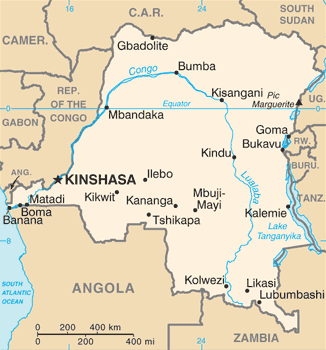 The Democratic Republic of the Congo is the third largest country in Africa after Sudan and Algeria and it is located in the heart of central Africa. The Democratic Republic of the Congo is also the fourth most populous country in Africa after Nigeria, Egypt, and Ethiopia. The Democratic Republic of the Congo is also home to the Congo River, which is the most powerful river in Africa and is the second largest river in the world by volume. The Congo River flows through the Congolese rainforests, which are home to many rare and endangered species, and then flows east into the Atlantic Ocean. These are all factors that make the Democratic Republic of the Congo essential to the Great Rift Valley and the great lakes region of Africa.
The Belgian Congo gained its independence from Belgium in 1960 and was known as the Democratic Republic of the Congo. In 1971 the name was changed to Zaire, but the original name of the Democratic Republic of the Congo was restored. When Joseph Kabila was elected the President of the Democratic Republic of the Congo he became the first democratically elected Congolese leader in over forty years. Prior to Kabila’s election had been ruled by dictators most recently Kabila himself. Joseph Kabila became dictator after his father, Laurent Desire Kabila, was assassinated in 2001. Despite many rumors that Kabila rigged the election, the emergence of a structured, democratic government offers hope to many Congolese citizens and to the international community.
Since the Congolese Civil War has result in the deaths of 3.9 million men, women, and children since the conflict erupted in 1998. Richard Brennan, the primary author of a study about the Congolese Civil War that was conducted by International Rescue Committee and published in the Lancet, cited the conflict in the Democratic Republic of the Congo as, “the deadliest crisis anywhere in the world over the past 60 years.” He also makes mention of the ignorance exhibited by the global community in regard to the scale and impact of the Congolese Civil War. The most prominent issue is domestic terrorists and rebels who are terrorizing the northeast and east regions of the Democratic Republic of the Congo.
The Democratic Republic of the Congo is one of the most problematic countries in Africa. The problems that face the Democratic Republic of the Congo are numerous and varied. One of the most prevalent issues are disputes between the Democratic Republic of the Congo and Uganda over oil rights in Lake Albert and ownership of Rukwanzi Island, which is a small island in the southern region of Lake Albert. Drinking water is another important issue for the Democratic Republic of the Congo to deal with.
The armed conflict between Congolese and Ugandan troops over Lake Albert’s oil ended a four-year peace between the two countries, which followed the Congo Wars between Ugandan and Congolese forces which lasted from 1997 to 2003. In 1997, Uganda backed Rwandan forces that helped Congolese rebels to overthrow Mobutu Sese Seko, the military dictator of Zaire (now Congo), but Uganda later opposed his successor Laurent Desire Kabila as well. After rising into power changed the name of the country from Zaire back to the Democratic Republic of the Congo. In 2001, Kabila was assassinated and he was succeeded by his son Joseph Kabila who is the current president of the Democratic Republic of the Congo. After his death the Ugandan military accused Laurent Kabila of arming rebels and began occupying cities in the east and north-east of Zaire (now Congo). In 2003, Ugandan and Rwandan forces began to pullout and were replaced by 17,500 UN Peacekeepers. After the conflict the International Court of Justice decided that Uganda must compensate the Democratic Republic of the Congo due to atrocities committed against Congolese civilians, which included rape, torture, and murder; another reason for the decision was the looting of Congolese resources by Ugandan forces.
Civil War
The civil war that now ravages the Democratic Republic of the Congo began in 1998 and is the most troublesome issue that is widely overlooked internationally and specifically the western world. The American People were outraged by the United States inaction during the genocide in Rwanda, particularly after the release of the film Hotel Rwanda. The civil war in the Democratic Republic of Congo has resulted in the death of 3.9 million people both from fighting and diseases caused by the conflict (according to a study conducted by the International Rescue Committee and published in the Lancet, a British medical journal). The 3.9 million deaths that have occurred during the civil war in the Democratic Republic of the Congo are nearly four times more than resulted from the genocide in Rwanda it is also makes the Congolese Civil War the most deadly conflict since World War II and the Holocaust. The Congolese Civil War has resulted in the deaths of more people than the conflict in Iraq, the conflict in Afghanistan, and the Genocide in the Darfur region of Sudan combined. This conflict is also one of the most disturbing as well with rebel militias raping women and spreading HIV/AIDS as a weapon, the Democratic Republic of the Congo is being stripped of its natural resources much as it was when it was ruled by Belgium, and most disturbingly, one rebel faction has been accused cannibalism stemming from reports that some rebels had murdered innocent Pygmies, who have no part in the conflict, and then ate them. The United States government now shows similar inaction in the Democratic Republic of the Congo, yet the uproar from the American public is seemingly nonexistent in comparison to the uproar that resulted from the United States’ inaction during the genocide in Rwanda. One factor which may contribute to the American public’s unawareness of this conflict is that the US is currently at war and most of the outcry for African struggles is about the genocide in the Darfur region of Sudan. Between early 2007 and April 2008 alone 550,000 people have fled from their villages in the eastern Congolese provinces of Ituri, North Kivu, and South Kivu.[i] Many who flee from their villages become malnourished and become more susceptible to many diseases which can kill them.
Although the Congolese Civil War officially ended the conflict continues and it is now concentrated primarily in the mountainous eastern provinces of Ituri, North Kivu, and South Kivu of the Democratic Republic of the Congo. There are an estimated 20,000 rebels in the east belonging to various rebel factions. These groups are responsible devastating entire villages as well as raping and murdering innocent civilians. The 17,000 UN peacekeeping troops in the Democratic Republic of the Congo is the largest UN peacekeeping force in the UN’s history and is known by the acronym MONUC. Of the 17,000 UN peacekeepers nearly ninety percent are stationed in the near-anarchical eastern provinces of Ituri, North Kivu, and South Kivu. The east has been a lawless region of the Democratic Republic of the Congo gained independence from Belgium in 1960. Since 1960, the east has lacked a structured government and has been primarily ruled by warlords and militia leaders. Among the rebel factions in the east are Hutu rebels, the ethnic extremists who were responsible for the genocide in Rwanda in 1994. Most Hutu rebels are members of the FDLR (Democratic Forces for the Liberation of Rwanda), who fled from Rwanda after the genocide ended in July 1994. President Kabila and the Congolese government have struggled to suppress these rebel militias in the eastern provinces, despite a strong military presence as well as the thousands of UN peacekeepers stationed in the east.
Another notable rebel faction was led by Jean-Pierre Bemba, a Congolese senator who lost to Joseph Kabila in the 2006 presidential election. Bemba went into exile in Portugal after his rebel backers were defeated by Congolese troops in 2007. In May 2008, Senator Bemba was arrested in Belgium and is now being charged for war crimes by the International Criminal Court.
Congolese rebel factions are funded in various ways mostly through the smuggling of natural resources, which robs the government of profit. When Rwandan troops were in the Democratic Republic of the Congo they looted many Congolese resources and then funded and backed Congolese rebel militias. But, even after Rwandan troops withdrew smuggling continued. In 2004, seventeen tons of ivory, which came from five-hundred to a thousand illegally poached elephants, were smuggled out of the Congolese province of Ituri alone.[ii] There have also been surprising reports that some UN peacekeepers are supplying Hutu rebels, whom they are supposed to be fighting, with ammunition in exchange for illegally poached ivory.[iii] In another report, Indian and Pakistani UN peacekeepers were accused by the BBC of exchanging their weapons with rebels from the FNI militia, a rebel militia operating in Ituri, in exchange for gold. Another concern in the Congolese forests of Ituri is the okapis. Okapis are a rare species of forest giraffes that are only found in the Ituri province, but during the war they were poached and their pelts were smuggled into neighboring Uganda where they were sold illegally to fund rebel militias in the Democratic Republic of the Congo.
Despite the ecological problems of war, peace could cause even more. If there was peace in the eastern provinces, international timber companies might be attracted to Congolese rainforests including those in Ituri. Industrial logging in the forests would devastate the now fragile ecosystems in the Congolese rainforests. The obvious threat is deforestation which would reduce the habitat of many endangered species including the okapis and several species of elephants. Logging is still occurring on a far smaller scale as rebels are smuggling timber in ways similar to coltan and other Congolese natural resources.
In the Ituri jungle a semi-nomadic people, the Pygmies, who still live and hunt in ways long forgotten in the western world, have been caught in the crossfire of this deadly conflict in the Ituri province. Pygmies are believed to have been the first people to settle in the area now known as the Democratic Republic of the Congo. Pygmies will go to villages and work in the fields in exchange for food and metal tools, but many farmers take advantage of the Pygmies. There have been disturbing accounts of members of a Congolese rebel faction, MLC (Movement for the Liberation of Congo), murdering and eating Pygmies in Ituri.
Unfortunately, Congolese civilians have frequently been victims of the Congolese Civil War often times women and children. Both Congolese rebels and the Congolese army have used rape as a barbaric weapon of war against innocent civilians during the civil war. Soldiers and rebels will often rape women in public places and force the victim’s family watch. Even worse is that some rebels will force men at gunpoint to rape their own mothers, sisters, and even daughters. Furthermore the UN Fund for Women and various other human rights organizations have estimated that hundreds of thousands of Congolese women and girls have been raped; however an exact figure is unattainable since the vast majority of rapes are not reported because social stigma brought on the victims. Roughly 4,500 cases of sexual violence were reported in the Congolese province of South Kivu in only the first six month of 2007. In addition, to that staggering figure the UN estimates that for everyone instance that is reports ten or twenty will go unreported because of the harsh social stigma brought upon the victims. Even more disturbing are some of the accounts of the vicious attacks. Some victims are as young as eighteen months and are raped in front of their parents and other victims are as old as seventy-five years old. In other accounts the assailants rubbed salt in the victims eyes until she was blind so as to ensure that she could not identify her attackers. Additionally, more than a quarter of Congolese rape victims contract HIV/AIDS. These women are then viewed as “contaminated” and they are shunned by their village and abandoned by their husbands. Also, many refugees feel when they reach a UN refugee camp that they are safe, but unfortunately women are raped in these camps everyday because of this false sense of security.
The effects of rape are not only felt emotionally and physically by the victim, but they are also felt by the village and local economy. Women would usually tend to the fields and harvest the crops, but now more and more women are staying inside. They fear that they could be abducted from their fields and raped. This has caused a rapid decline in agricultural production which has crippled many localized economies and also has caused many to go hungry. These violent rapes have also destroyed the trust many Congolese women once had since many of these assaults were committed by neighbors, taxi drivers, and even teachers.
[i] Economist atrocities beyond words
[ii] National Geographic a hole in the forest sep. 2005
[iii] economist
Images from:
http://en.wikipedia.org/wiki/Democratic_Republic_of_the_Congo#Civil_Wars
Subscribe to:
Comments (Atom)