Showing posts with label cell phones. Show all posts

Wednesday, June 24, 2009

Movies to Raise Awareness


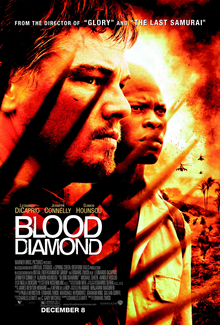
Why does Hollywood succeed at raising awareness when the mainstream media fails? Drama captures one’s attention and emotions much more effectively than words on a page or a monotone newscaster. When an issue reaches the silver screen it can no longer be swept under the rug. Movies like Hotel Rwanda, The Last King of Scotland, and Blood Diamond have recently had this effect.

Charles Lindbergh once said, “How can there be writhing, mangled bodies? … It is like listening to a radio account of a battle on the other side of the earth. It is too far away, too separated to hold reality.” Lindbergh was speaking of the Holocaust, but his words hold true today. Many people hear reports of conflicts in Africa on the news and then forget about it twenty minutes later, it isn’t their country or their people so they are not interested. They are simply statistics scrolling past them on the bottom of the television screen. But, in movies the drama captivates and the tragedies can no longer be ignored.
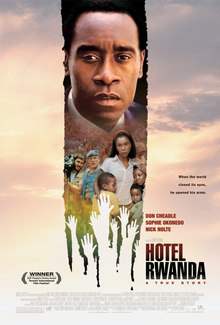
Hotel Rwanda is probably the most important of the three aforementioned films because it made genocide real to the world. People began to remember the Rwandan Genocide and began to recognize the genocide in Darfur, Sudan. One of the things that made Hotel Rwanda great is that it is a true story of good prevailing against all odds. Moreover, the film captures the complexity of the conflict, the slaughter, the brutality, ethnic history, political stalemate, the press coverage, the hopelessness of the Red Cross, and the struggle to persevere. The story does not simply display the Rwandans as savages; it also displays the innocent and those who felt obligated to do the right thing.

The Last King of Scotland is a fictional account of Idi Amin’s regime in Uganda in the 1970’s. Though the story of the Scottish doctor is fictional the movie reveals many truths about Idi Amin and the stereotype harsh African dictator. Like Hotel Rwanda, The Last King of Scotland was made long after the events it portrays. The problem with this is that it allows some viewers to believe that the realities of these films are outdated. Although Blood Diamond is a work of fiction, it places the viewer in the present with the real issue of conflict diamonds. As a result of the movies message much more attention has been paid to conflict diamonds and other conflict minerals. Activists and authors have directed attention not only to conflict diamonds but to conflict minerals, such as columbite tantalite in the Democratic Republic of the Congo which is used in cell phones, laptops, and Sony Playstations (cf. “The Congo’s Resource Curse” in the archives).

Film is a valuable asset when raising awareness for a cause and it has been very effective in raising attention for Africa. However, serious movies about Africa come out bi-annually at the most (probably less frequently than James Bond movies). The effectiveness of these films are unquestionable but Hollywood should still do more to raise awareness for Africa. Many celebrities who are advocates for African causes should consider film as a means to make a difference. Perhaps Oprah should produce a movie about Africa or Angelina Jolie should seek out a role in a movie about Africa.

Images from Wikipedia

Tuesday, March 17, 2009

The Congo's Resources Curse

The Democratic Republic of the Congo is arguably one of the most mineral-rich countries in the world. The Democratic Republic of the Congo has vast deposits of oil, coltan (columbite-tantalite), cobalt, copper, gold, silver, uranium, diamonds, zinc, manganese, tin, and coal. The Democratic Republic of the Congo has been a major trade partner of the United States in the past and continues to be as in 2006 58.4% of Congolese exports went to the United States.[i] In fact, when under the colonial rule of Belgium, the Belgian Congo (now Democratic Republic of the Congo) provided the United States with the uranium used in the nuclear bombs dropped on Hiroshima and Nagasaki.
Columbite-tantalite is an ore, more commonly known as coltan, which is a notable Congolese export that is rapidly gaining value in the global marketplace. Coltan is an essential component of cell phones, laptops, Sony PlayStations, and weapons systems. The price of coltan skyrocketed from $18 per pound in 1998 to $380 in 2000.[ii] This spike in the price has had a profound effect on the Congolese economy since 80% of the known coltan mines are in the Democratic Republic of the Congo. Coltan was one of the many natural resources looted by Rwandan troops when they were supposedly in the Democratic Republic of the Congo to pursue Hutu militants responsible for the Rwandan genocide who fled from Rwanda into the eastern Congolese provinces. There are also Tutsi insurgents in the eastern provinces, who are seeking revenge against Hutu rebels. Most organized Tutsi insurgents are led by General Laurent Nkunda. In December 2008, Congolese President Joseph Kabila deployed 25,000 troops into suppress Nkunda’s insurgency in the east.
There is evidence that shows how in 1998 Rwandan troops looted 1,500 tons of coltan, which the Democratic Republic of the Congo had been stockpiling for seven years, and shipped it to the Rwandan capital of Kigali. At the time that amount of coltan would have been worth only $54 million; however two years later that quantity would be worth $1.14 billion, because the value skyrocketed due to a rapidly growing demand for coltan in cell phones, laptops, and Sony PlayStations. Due to the Congolese Civil War, Congolese exports of coltan decreased in 2000 and caused a shortage of the Sony PlayStation 2 during the holiday season.
Rwandan troops looted many Congolese natural resources including coltan, gold, diamonds, timber, and coffee in the late 1990’s. There are several Rwandan export statistics which blatantly demonstrate looting of Congolese mines by Rwandan troops. Rwanda did not produce any coltan in 1999, but Rwanda exported 69.5 tons of coltan that year. Since only a pick and shovel are needed to mine coltan Rwandan troops would often force prisoners or impoverished Congolese village people to mine the coltan. Although Rwanda has no diamond mines, Rwandan diamond exports increased from 166 carats in 1998 to 30,500 carats in 2000. That same year Rwanda produced a mere 0.0044 tons of gold, yet Rwandan gold exports totaled 10.83 tons. All of these increases were due to Rwandan forces looting Congolese mines.
Copper serves as an exemplar of the devastating economical effects of the Congolese Civil War and the Congo wars. Copper was once an essential Congolese export, but copper production in the Democratic Republic of the Congo has declined exponentially due to the Congo wars and the Congolese Civil War. In the 1980’s Gecamine, a government owned mining company, produced up to 470,000 tons of copper; however, in 2005, Gecamine only produced 14,000 tons.[iii]
Furthermore, the Congolese government is reviewing the legality sixty-five mining contracts which were granted before the most recent Congolese election. It is feared that many warring factions and corrupt government officials granted these contracts for their own personal gain. The deputy mines minister, Victor Kasongo, explained to the press, “The aim is to bring the Congo to the stage where things are clear, legal and beneficial for all the parties.” In addition to these unlawful contracts the Congolese government has struggled to collect royalties. In 2006, Congolese mining royalties were estimated at $160 million, but the Congolese government only collected a mere $32 million in mining royalties.[iv]
China offered to invest $8.5 billion dollars to build roads, railroads, schools and hospitals; however unlike most relief funds China’s investment would also be used to resurrect the Democratic Republic of the Congo’s once lucrative mining industries. China also built a railroad that is roughly 2,000 miles long from Congolese mines in southeastern Democratic Republic of the Congo to the Congolese silver mines near the Atlantic coast. It would be prudent for the United States to take similar action in the mineral rich regions of Africa so as to improve African relations and ensure natural resource imports. India and Brazil are both discussing similar investments with the Democratic Republic of the Congo.

[i] Pg 114 of a game as old as empire
[ii] A Game as Old as Empire
[iii] Mining firms face Congo crackdown; Ben Laurance Sunday Times of London 10-21-2007
[iv] Mining firms face Congo crackdown; Ben Laurance Sunday Times of London 10-21-2007