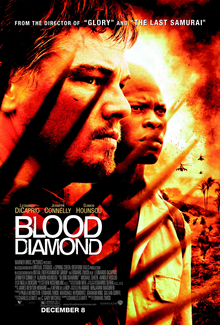
Why does Hollywood succeed at raising awareness when the mainstream media fails? Drama captures one’s attention and emotions much more effectively than words on a page or a monotone newscaster. When an issue reaches the silver screen it can no longer be swept under the rug. Movies like Hotel Rwanda, The Last King of Scotland, and Blood Diamond have recently had this effect.
Charles Lindbergh once said, “How can there be writhing, mangled bodies? … It is like listening to a radio account of a battle on the other side of the earth. It is too far away, too separated to hold reality.” Lindbergh was speaking of the Holocaust, but his words hold true today. Many people hear reports of conflicts in Africa on the news and then forget about it twenty minutes later, it isn’t their country or their people so they are not interested. They are simply statistics scrolling past them on the bottom of the television screen. But, in movies the drama captivates and the tragedies can no longer be ignored.
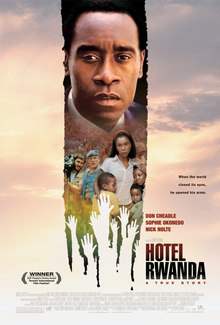
Hotel Rwanda is probably the most important of the three aforementioned films because it made genocide real to the world. People began to remember the Rwandan Genocide and began to recognize the genocide in Darfur, Sudan. One of the things that made Hotel Rwanda great is that it is a true story of good prevailing against all odds. Moreover, the film captures the complexity of the conflict, the slaughter, the brutality, ethnic history, political stalemate, the press coverage, the hopelessness of the Red Cross, and the struggle to persevere. The story does not simply display the Rwandans as savages; it also displays the innocent and those who felt obligated to do the right thing.
The Last King of Scotland is a fictional account of
 Idi Amin’s regime in Uganda in the 1970’s. Though the story of the Scottish doctor is fictional the movie reveals many truths about Idi Amin and the stereotype harsh African dictator. Like Hotel Rwanda, The Last King of Scotland was made long after the events it portrays. The problem with this is that it allows some viewers to believe that the realities of these films are outdated. Although Blood Diamond is a work of fiction, it places the viewer in the present with the real issue of conflict diamonds. As a result of the movies message much more attention has been paid to conflict diamonds and other conflict minerals. Activists and authors have directed attention not only to conflict diamonds but to conflict minerals, such as columbite tantalite in the Democratic Republic of the Congo which is used in cell phones, laptops, and Sony Playstations (cf. “The Congo’s Resource Curse” in the archives).
Film is a valuable asset when raising awareness for a cause and it has been very effective in raising attention for Africa. However, serious movies about Africa come out bi-annually at the most (probably less frequently than James Bond movies). The effectiveness of these films are unquestionable but Hollywood should still do more to raise awareness for Africa. Many celebrities who are advocates for African causes should consider film as a means to make a difference. Perhaps Oprah should produce a movie about Africa or Angelina Jolie should seek out a role in a movie about Africa.
Images from Wikipedia

